Needham, Bernstein, and BofA Issue SpaceX Stock Forecasts
Needham, Bernstein, and BofA have issued new forecasts for SpaceX stock as Wall Street analysts project strong growth driven by Starlink and reusable rockets, though high valuations pose risks for long-term retail investors.


Accumulating millionaire gains from SpaceX stock is possible, but currently appears to be a long-term project spanning decades rather than an immediate Tesla-style windfall, primarily because the shares are currently valued very steeply. Following a 1.85% decline on October 1, the SpaceX stock price trades at $148.07, remaining close to its initial debut level and keeping early SpaceX stock returns relatively modest. Meanwhile, Wall Street presents an optimistic SpaceX stock forecast, with 37 analysts projecting an average 12-month SpaceX price target of $226, supported by strong SpaceX stock growth as second-quarter revenue surged 92% to reach $7.8 billion.
SpaceX Stock Returns: Can Its Growth Make Investors Millionaires?
Why Tesla’s Run Sparked The Question
Since going public in 2010, Tesla shares have delivered an average annual return of 40.11%, meaning an initial $5,000 investment back then would exceed $1 million today. Consequently, when Elon Musk took SpaceX public on the Nasdaq on June 12, 2026, trading under the ticker SPCX, many investors began wondering if they could achieve similar millionaire status with SpaceX stock.
That milestone has already been reached by some; estimates suggest more than 4,000 current and former employees became millionaires through the IPO. However, retail investors who purchased shares at the debut face a different reality, as the SpaceX stock price has remained close to its opening level, resulting in minimal early public returns.
Ultimately, achieving millionaire status through SpaceX stock relies heavily on the company’s performance over the coming decades.
SpaceX Stock Forecast: Needham Sees $250, Bernstein $248, BofA $235
Wall Street maintains a predominantly positive outlook for the shares. Among 37 ratings issued over the past three months, 30 analysts recommend a Buy, five suggest a Hold, and two issue a Sell, placing the average 12-month SpaceX price target at $226—roughly 52.63% above current levels. Individual targets range from a bullish high of $450 to a bearish low of $140.
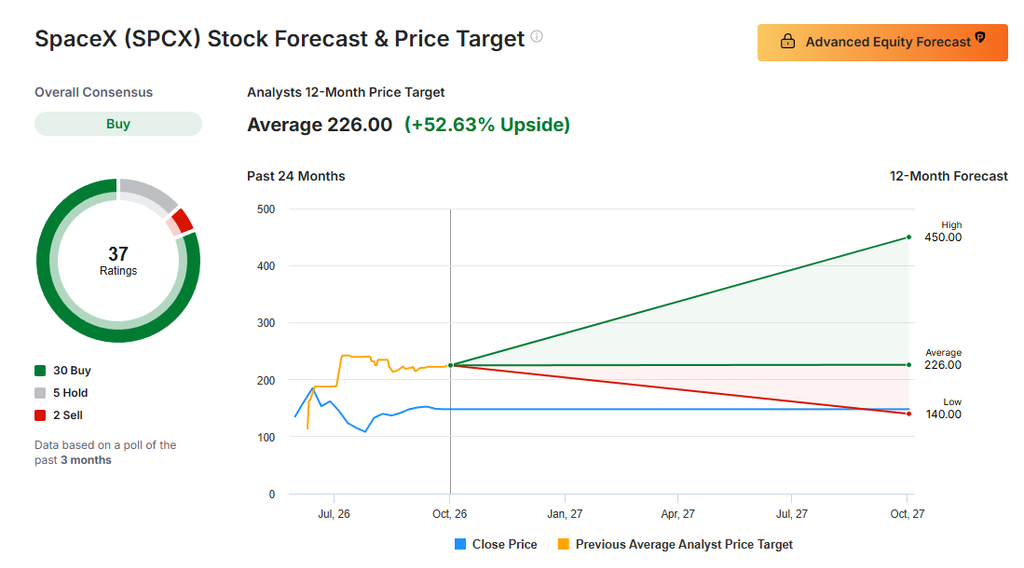
Recent updates include prominent financial institutions adjusting their outlooks. Needham holds the highest SpaceX price target at $250, followed by Bernstein SocGen Group at $248, BofA Securities at $235, UBS at $210, and Mizuho at $200. All five institutions reaffirmed their Buy ratings on September 29 and 30.
Anticipated SpaceX stock growth is heavily driven by reduced launch expenses. Reusable Falcon 9 boosters have already significantly decreased launch costs, while Starship—engineered by SpaceX to be fully reusable—could reduce expenses further and improve profit margins.
Starlink Fuels Hopes
Starlink serves as the primary driver behind current hopes for millionaire returns on SpaceX stock. The satellite internet service concluded the second quarter with 12 million subscribers, doubling its customer base from the previous year, while quarterly connectivity revenue increased by 66% to $4.29 billion.
During the earnings call, Elon Musk remarked:
“I think people are really underestimating Starlink here”
Mizuho, which maintains an Outperform rating and a $200 SpaceX price target, noted:
“SpaceX is not a rocket company. It is the infrastructure layer of the orbital economy.”
Additionally, the company reduced its net loss to $541 million from $1 billion the prior year. Musk has highlighted internal projections targeting $1 trillion in annual revenue by 2030. Should SpaceX approach these figures, current forecasts may prove overly conservative, and investors seeking substantial gains are essentially banking on this trajectory.
Why The Valuation Carries Real Risk
Conversely, the high valuation presents substantial risk. With a market capitalization of approximately $2 trillion, SpaceX trades at 200 times forward earnings, meaning much of its future growth is already priced into the shares. Over the past 52 weeks, the SpaceX stock price has fluctuated between $104.83 and $225.64, a level of volatility that investors targeting large gains must anticipate.
Additional insider share lockups expiring on October 9 and October 24 could introduce near-term pressure on the SpaceX stock forecast. Furthermore, Starship Flight 14, scheduled by SpaceX for September 28 with the goal of achieving its first orbital flight, poses immediate risks; an unsuccessful test could negatively impact the shares rapidly.
Achieving a repeat of Tesla’s historical gains presents a challenging mathematical hurdle. Replicating Tesla-style SpaceX stock returns over the next 16 years would require the company to reach a valuation of roughly $441 trillion—about 14 times the annual U.S. GDP—a scenario described by the Motley Fool as highly improbable.
Ultimately, realizing millionaire returns on SpaceX stock will likely require buying during sharp market dips and holding for approximately 30 years for most retail investors. While long-term SpaceX stock growth over such a timeframe could yield significant results, and 30 out of 37 covering analysts maintain Buy ratings, dissenting views exist, as reflected by the lowest SpaceX price target of $140. Given the expected volatility, transforming a $5,000 investment today into a millionaire portfolio requires the company to expand well beyond its present valuation.
Frequently Asked Questions
01What is the current ticker symbol and public market debut date for SpaceX?
SpaceX trades on the Nasdaq under the ticker symbol SPCX, following its public debut on June 12, 2026.
02What are some of the top Wall Street price targets for SpaceX?
Needham has set a target of $250, Bernstein SocGen Group follows at $248, BofA Securities at $235, UBS at $210, and Mizuho at $200, with an overall average 12-month target of $226.
03What is driving SpaceX’s recent revenue growth?
Growth is heavily driven by Starlink, which reached 12 million subscribers and generated $4.29 billion in quarterly connectivity revenue, alongside expanding launch capabilities utilizing reusable rockets.