Is It Time to Sell Micron Stock Despite Record Revenue?
Despite reporting record fiscal 2026 revenue and strong long-term supply agreements, Micron investors are weighing whether to sell MU stock amid concerns over slowing NAND prices and uncertain AI spending.


Are you wondering whether to sell your MU stock right now? For the majority of long-term investors, the prevailing advice is to hold, at least for the time being. Micron’s Q4 fiscal 2026 earnings reached a record $54.23 billion in revenue, and the company currently projects that memory supply will remain constrained through 2028. However, potential vulnerabilities persist regarding Micron NAND prices—following a warning from Kioxia about decelerating price increases—alongside fresh uncertainties surrounding AI spending. MU stock currently trades at $884.74, and while the broader Micron stock forecast from analysts remains optimistic, it is accompanied by several notable caution signals.
Micron Stock Outlook: NAND Prices, AI Spending And Earnings
Today, MU stock trades roughly 27% lower than its 12-month peak of $1,213.56, though it still reflects an approximate 339% surge from its low point of $201.37. This dramatic volatility is the primary catalyst driving investors to ask, “Should I sell MU stock and lock in my profits?” The visual below maps out this entire market journey.
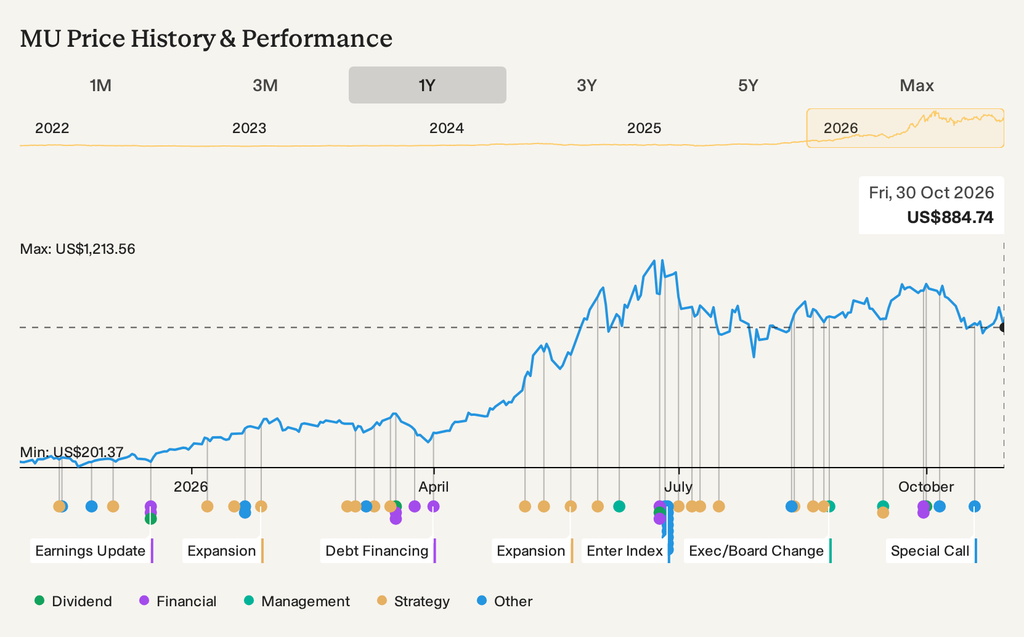
Record Micron Earnings And An Even Stronger Outlook
For the entirety of fiscal 2026, Micron generated $133.19 billion in revenue and issued guidance for approximately $61.5 billion in Q1 fiscal 2027 revenue, give or take $1.5 billion. Furthermore, long-term supply agreements secure over 35% of the company’s revenue through the year 2030.
Sanjay Mehrotra, Chairman and CEO of Micron Technology, stated:
“Micron delivered record fiscal 2026 results, and we expect an even stronger fiscal 2027. AI is becoming Super Intelligence (SI), and memory enhances this intelligence and the competitiveness of our customers’ platforms. We are increasing our investments in technology, products and manufacturing to help drive SI forward with our customers, and our Strategic Customer Agreements provide added confidence in the durability of Micron’s financial performance.”
These binding agreements serve as the most robust defense for anyone debating whether to sell MU stock ahead of a potential cycle shift.
Micron NAND Prices Slow As AI Spending Gets Tested
Market pressure is currently stemming from industry competitors. While SK Hynix has highlighted tight memory conditions, Kioxia has cautioned that NAND price growth is slowing down, and Intel has pointed to elevated memory expenses. This conflicting set of indicators explains why the question regarding selling MU stock has resurfaced so frequently.
A softening in Micron NAND prices would arrive at a challenging juncture, given that Micron maintains a heavy capital expenditure burden. Any moderation in AI capital expenditures, or more aggressive price reductions by competitors such as SK Hynix, Samsung, or Kioxia, would directly impact that same foundation of contracted revenue. Thus far, this market noise has not materially altered Micron’s internal demand projections. Even so, should Micron NAND prices continue to cool heading into 2027, the rationale for selling MU stock could shift rapidly.
Should I Sell MU Stock? What The Micron Stock Forecast Says
The primary Micron stock forecast monitored by Simply Wall St projects $320.4 billion in revenue and $217.9 billion in earnings by the year 2029. Based on this perspective, the intrinsic fair value stands roughly 76% above current trading levels. Conversely, more conservative analysts anticipate only $236.3 billion in revenue alongside $207.2 billion in earnings, paired with a P/E ratio near 6x. Additionally, one of the 28 alternative fair value assessments indicates potential downside of 38%. For anyone evaluating whether to sell MU stock, this divergence in forecasts is the critical metric to monitor.
Ultimately, the decision to sell MU stock depends on your outlook: if you remain confident that sustained AI demand will keep memory supplies tight, the company’s contracts and financial guidance argue in favor of holding. Conversely, if you purchased near the $1,213 high and feel uncomfortable weathering another significant downturn, trimming a portion of your holdings serves as a reasonable compromise. With MU stock trading well below its peak values, upcoming Micron earnings reports and any new developments in NAND pricing will likely determine which perspective proves correct.
Frequently Asked Questions
01What was Micron’s revenue for fiscal 2026?
Micron achieved record fiscal 2026 results with $133.19 billion in revenue, which included $54.23 billion in revenue specifically for the fourth quarter.
02What are the concerns regarding Micron NAND prices?
Concerns arose after Kioxia issued warnings about slower price gains for NAND memory, alongside high memory cost flags from Intel and conflicting signals from competitor SK Hynix.
03How much of Micron’s future revenue is secured by long-term deals?
Long-term strategic customer agreements currently cover over 35% of Micron’s revenue through the year 2030.
04Where does MU stock trade relative to its 12-month high?
MU stock trades at $884.74, which sits about 27% below its 12-month high of $1,213.56, though it remains up roughly 339% from its low of $201.37.