Micron Stock Praised by Musk as 26 Deals Ease Memory Cycle Risks
Micron Technology stock received a public endorsement from Elon Musk following fair pricing praise, while 26 long-term customer deals aim to ease traditional memory cycle risks and secure future revenue through 2030.


Micron Technology stock received a public endorsement from Elon Musk on October 13, 2026, after the Tesla and SpaceX chief executive officer stated that Micron has maintained fair pricing on future memory products, contrasting it with competing vendors. This remark comes as Micron memory costs hover near all-time highs, and as the company’s customer agreements—specifically 26 long-term deals extending through at least 2030—now account for more than 35% of its total revenue. This financial buffer also influences the MU stock outlook by potentially cushioning the impact of the next downturn within the traditional Micron memory cycle.
MU Stock, Elon Musk’s Praise, and Micron’s Memory Price Risks
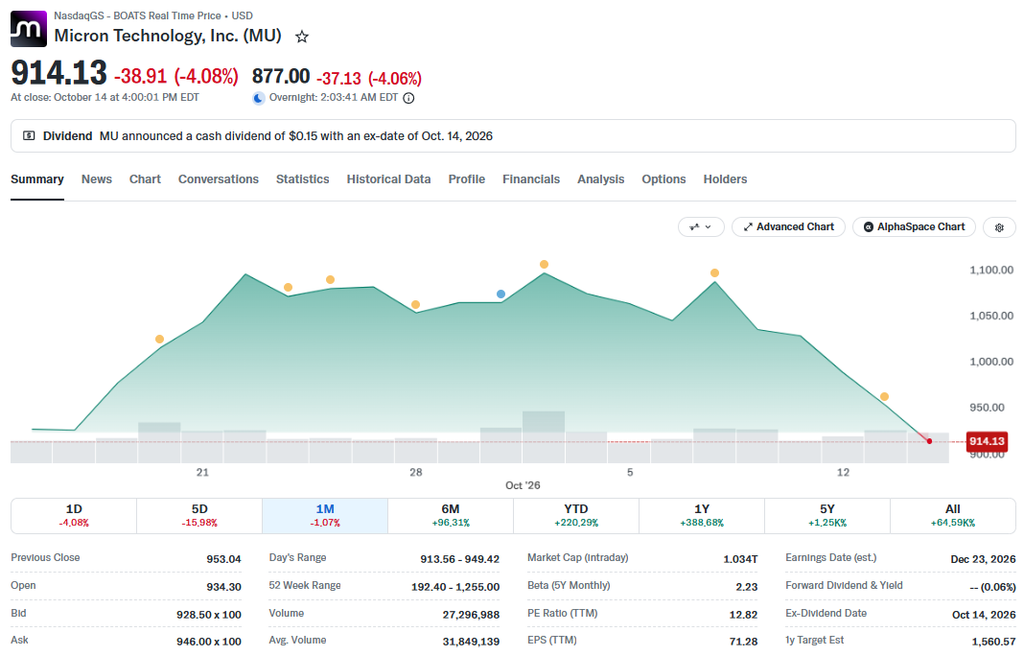
Elon Musk’s remarks provided a brief boost to MU stock, driving shares up 0.7% in overnight trading on Tuesday. However, the upward momentum failed to sustain itself. Micron shares finished at $914.13 on October 14, marking a 4.08% decline, and further dropped to $875.15 during overnight sessions. Currently, the stock is down nearly 16% over a five-session span amid a broader semiconductor sell-off, though it retains a year-to-date gain of approximately 220%.
What Elon Musk Said About Micron
Musk responded on the platform X to institutional TMT research analyst Nicholas Mugalli, who had circulated a bullish research note on memory from JPMorgan. Elon Musk commented:
“Micron has been reasonable regarding future memory prices, while others have been extortionate, which is something today’s customers won’t forget. Micron is making is the smart move for long-term customer loyalty.”
His statements hold significance for MU stock because Elon Musk operates as a major purchaser of memory components. His venture xAI, which is now part of SpaceXAI, operates the Colossus AI data-center complex located near Memphis, where the installed Nvidia GPUs rely on Micron memory. Furthermore, Musk identified Micron as an active supplier back in April while discussing his Terafab initiative.
How Micron’s Customer Contracts Change The Memory Cycle
Micron’s customer agreements offer a layer of insulation against the volatility of the Micron memory cycle that the company has not experienced previously. Three-quarters of the anticipated revenue from these arrangements features price bands establishing specific upper and lower limits, while the remaining portion is negotiated based on prevailing market rates. Buyers have additionally secured commitments totaling $32 billion, primarily through cash deposits. Micron Chief Executive Officer Sanjay Mehrotra noted:
“To date, we have signed 26 SCAs, which we currently estimate to be over 35% of our revenue through 2030.”
According to Mugalli, Micron also maintains a contracted backlog valued at $150 billion, with over 75% of its fiscal 2027 production volume already pre-sold. This substantial backlog helps clarify why the MU stock highlighted by Elon Musk continues to attract strong demand from buyers seeking guaranteed supply.
What The MU Stock Forecast Depends On
The cyclical nature of the memory market remains intact. Bernstein forecasts that DRAM pricing will advance another 43% in 2027 before declining by 53% in 2028, whereas JPMorgan anticipates that supply shortages will persist through 2028. Mehrotra stated:
“We expect memory and storage supply-demand conditions to be much tighter in calendar 2027 and 2028 than they were in 2026.”
Rising Micron memory prices drove the vast majority of financial growth this year, with DRAM selling prices climbing approximately 180% during fiscal 2026 while shipment volumes grew by only the mid-20% range. Total revenue surged 256% to reach roughly $133 billion, though the equity currently trades at roughly 13 times earnings—an indication that the market anticipates profitability to moderate when market pricing declines. Additional competitive pressure is also stemming from Chinese rival CXMT through the introduction of denser DRAM architectures.
Regarding the broader MU stock outlook, long-term contracts and the endorsement from Elon Musk provide notable backing, but approximately 74% of Micron’s sales remain directly sensitive to shifts in supply and demand. Consequently, MU stock will encounter its ultimate test when Micron memory pricing eventually shifts downward.
Frequently Asked Questions
01Why did Elon Musk praise Micron?
Elon Musk praised Micron on X for maintaining fair and reasonable future memory pricing compared to other competing vendors, which he noted helps build long-term customer loyalty.
02How do Micron’s long-term customer contracts affect its business?
Micron has secured 26 long-term customer agreements covering over 35% of its revenue through 2030. Three-quarters of this contracted revenue includes price bands that create upper and lower limits, helping buffer the company against the volatility of the memory cycle.
03What percentage of Micron’s fiscal 2027 output is already sold?
Over 75% of Micron’s anticipated fiscal 2027 production output has already been sold, supported by a $150 billion contracted backlog.