
Trump Portfolios Sell Micron Shares and Purchase $25M in Meta
Financial disclosures reveal that Trump's third-party managed brokerage accounts sold up to $515,000 in Micron shares while purchasing millions in Meta stock during August, reflecting strategic artificial intelligence sector positioning.


Based on a financial disclosure provided by the U.S. Office of Government Ethics, Trump’s accounts have sold shares of Micron and purchased Meta stock. During August, his brokerage accounts offloaded between $251,000 and $515,000 worth of Micron Technology (MU) shares. Conversely, the same regulatory filing reveals a much larger acquisition of Meta stock, featuring net purchases ranging from $5.1 million to $25.3 million, marking the largest single buy of that month.
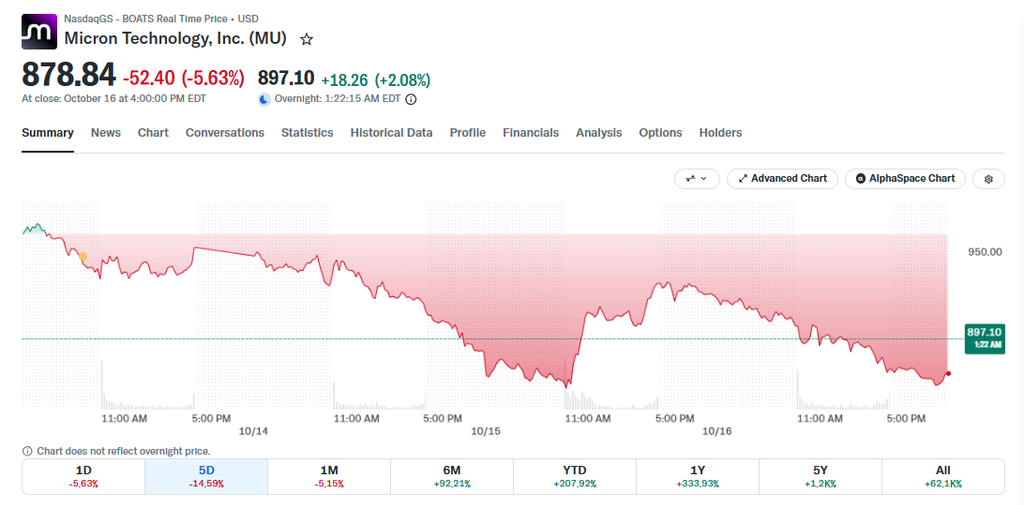
The development regarding the offloading of Micron shares coincides with an ongoing Micron stock selloff, drawing renewed interest toward Meta stock investments and the broader Micron versus Meta stock comparison.
Micron Stock Outlook, Meta’s AI Growth And Trump’s Portfolio Shift
The document details more than 500 individual trades made in August. Because independent third-party institutions manage these accounts, the president did not personally select the securities. Even so, the reallocation—selling Micron while acquiring Meta—highlights how these asset managers are positioning portfolios within the artificial intelligence sector.
Why Trump Sells Micron Stock After A Record Year
Micron produces DRAM, NAND, and high-bandwidth memory chips that supply data to artificial intelligence hardware. Spurred by an AI-driven memory shortage, fiscal fourth-quarter revenue surged 379% to $54.23 billion. Micron CEO Sanjay Mehrotra commented on the financial results in the earnings release:
“Micron delivered record fiscal 2026 results, and we expect an even stronger fiscal 2027.”
Despite these gains, Micron holds the third-position in memory market share, trailing behind SK Hynix and Samsung. Morningstar analyst William Kerwin noted:
“We do not believe Micron has an economic moat. We view DRAM and NAND as commodity-like products prone to market supply/demand dynamics and steady pricing erosion.”
One primary factor behind the liquidation of Micron shares is the underlying concern that memory prices and associated profit margins could decline once the current supply shortage eases.
At the time of writing, the broader Micron stock selloff has intensified. MU shares closed at $878.84 on October 16, marking a 5.63% drop for the day and a 14.59% loss over a five-session period, though the stock remains up approximately 208% for the year.
Why Trump Buys Meta Stock As AI Spending Pays Off
Meta operates platforms such as Instagram, WhatsApp, and Facebook, and reported a 28% increase in second-quarter revenue to $60.8 billion, driven by higher ad prices and increased ad impressions. Furthermore, the tech giant introduced Muse in September, an AI agent designed to assist both businesses and consumers with various tasks. CEO Mark Zuckerberg shared his perspective during the product launch:
“Everyone will have an exceptionally capable personal agent that understands you, your goals, and everything you care about.”
Analysts at Morgan Stanley believe Meta’s extensive data assets place the company in an advantageous position to dominate the consumer AI agent space. In August, Meta shares traded nearly 30% below previous highs amid market apprehension regarding AI expenditures, rendering a Meta stock investment comparatively inexpensive. This market dip likely accounts for why the accounts acquired significant amounts of Meta stock while scaling back Micron holdings to a much smaller degree.
Micron Vs Meta Stock After The Filing
Aside from the divestment of Micron shares, a comparative look at Micron versus Meta stock shows Micron trading at a lower valuation—approximately 12 times earnings—compared to roughly 27 times earnings for Meta. However, Wall Street projections anticipate that Meta will grow its earnings by about 20% annually over the next three years.
This valuation gap forms the core of the Micron versus Meta stock debate. A Meta stock investment relies on consistent advertising revenue, whereas Micron offers higher volatility in both directions, as illustrated by the recent Micron stock selloff. Because the accounts unloaded a maximum of $515,000 in Micron shares while investing up to $25.3 million into Meta, the portfolio disclosure ultimately reflects a significantly heavier financial commitment to Meta than to memory chips.
Frequently Asked Questions
01Did Trump personally choose to sell Micron and buy Meta stock?
No. According to the financial disclosure, independent third-party institutions manage these brokerage accounts, meaning the trades were executed by portfolio managers rather than by Trump directly.
02How much Micron stock was sold in August?
The accounts sold between $251,000 and $515,000 worth of Micron Technology (MU) shares during the month of August.
03What was the scale of the Meta stock purchase?
The filing revealed net purchases of Meta stock ranging from $5.1 million to $25.3 million, making it the largest buy of the month across the portfolio.
04Why are analysts concerned about Micron’s long-term outlook?
Analysts, such as those at Morningstar, point out that products like DRAM and NAND function similarly to commodities, making them vulnerable to changing supply and demand dynamics and potential long-term price erosion once the current AI-driven memory shortage subsides.


