Elon Musk’s Wealth Drops $48.5B Following SpaceX Stock Plunge
Elon Musk's net worth fell by over $48.5 billion after SpaceX shares dropped amid a broader market selloff and growing AI bubble concerns, following a massive chip leasing deal.


Elon Musk’s net worth slid to $865 billion, bringing his total wealth reduction to more than $48.5 billion on Friday, according to Bloomberg data. This drop stemmed from SpaceX shares falling to $134.72—about 40% beneath their post-IPO peak—amid a wider US market selloff driven by AI bubble concerns. Anyone checking SpaceX stock today will find it at its lowest valuation since August, arriving merely weeks after Musk regained his trillionaire status.
SpaceX Stock Decline Raises AI Bubble Fears as Musk’s Wealth Falls
SpaceX made its Nasdaq debut under the ticker SPCX on June 12, 2026, opening at $135 per share before reaching an all-time high of $225.64 four days later. Although shares recovered to $176.56 last month, another descent quickly followed. This rapid fluctuation helps explain why the drop in Musk’s fortune feels so severe.
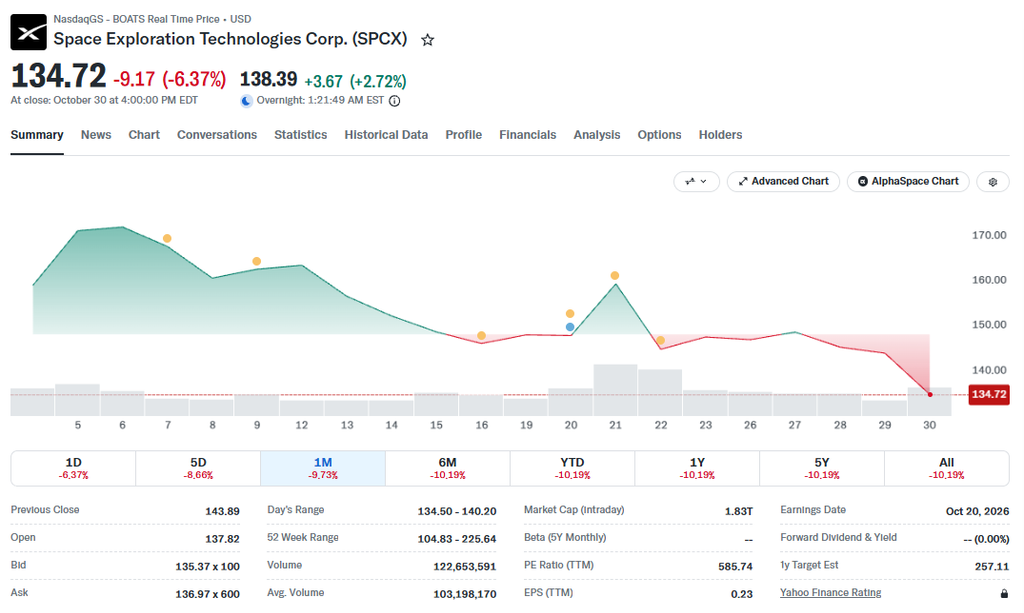
Source: Yahoo Finance
Presently, reviewing SpaceX stock today reveals that shares sit just beneath their initial IPO price. The equity shed $9.17, or 6.37%, during Friday’s session alone, marking a 9.73% loss over the preceding month. Because the majority of Musk’s wealth is tied up in SpaceX, his overall net worth reduction closely tracks this trajectory.
The $40 Billion Lease That Spooked The Market
On Oct. 26, SpaceX revealed an approximate $40 billion leasing agreement with a subsidiary managed by Apollo Global Management. This entity will purchase Nvidia’s upcoming Vera Rubin chips and lease them back to SpaceX across a roughly five-year window starting in 2027. The erosion of Musk’s wealth accelerated in the days following this announcement.
Chief Financial Officer Bret Johnsen commented:
“This lease diversifies our funding sources and addresses a notable portion of the funding required to deliver on our growth plans.”
He also projected fourth-quarter capital expenditures to range between $35 billion and $40 billion, up from $19.6 billion during the third quarter.
AI Revenue Beats Starlink, But The Bill Keeps Growing
The financial report released on Oct. 20 appeared robust initially. Total revenue climbed 161% to reach $14.58 billion, with AI-related revenue hitting $7.56 billion—surpassing Starlink’s $5.24 billion. At the same time, the AI division spent $16.4 billion, exceeding the combined outlays of the space and connectivity divisions, which heavily contributed to the decline in Musk’s fortune.
Musk himself has previously issued warnings regarding smaller cloud service providers, sharing the following perspective on X:
“As of the past few weeks, debt markets have almost entirely shut off access to money for any company that doesn’t have substantial revenue independent of AI data centers.”
He further noted:
“That means the 200+ neoclods are going to see guppy-level death and consolidation. Some will make it through, but not many.”
Industry peers including CoreWeave, Nebius, and IREN have each surrendered more than half their peak valuations, fueling broader worries regarding an AI market bubble alongside Musk’s financial pullback.
Tesla Merger Talk Softens Musk’s Fortune Decline
Tesla provided some financial cushion for Musk, concluding the week at $400 following his confirmation that he is evaluating a potential merger between the two entities. Dan Ives of Yorkville Ives estimates the probability of such an agreement occurring by the end of 2027 at 80% to 90%. Because Musk holds roughly a 49% stake in SpaceX, any downward movement in SpaceX stock impacts his total wealth far more significantly than his roughly 12% stake in Tesla can counterbalance.
At present, the stability of Musk’s net worth hinges on whether the broader AI market discovers a bottom. Any subsequent decline in SpaceX shares would pull his fortune lower still, while lingering AI bubble anxieties will likely dictate whether current stock levels establish a firm floor once the $35 billion to $40 billion expenditure initiative begins yielding measurable outcomes.
Frequently Asked Questions
01Why did Elon Musk’s net worth drop significantly?
Elon Musk’s net worth declined largely due to a 40% drop in SpaceX stock from its peak, driven by a wider US market selloff and growing concerns over an AI sector bubble.
02When did SpaceX go public, and what was its peak price?
SpaceX was listed on Nasdaq under the ticker SPCX on June 12, 2026, at an initial price of $135 per share, and reached an all-time high of $225.64 four days later.
03How does the $40 billion lease impact SpaceX?
The lease agreement involves an Apollo Global Management-run entity purchasing Nvidia’s Vera Rubin chips and leasing them back to SpaceX over five years starting in 2027. It diversifies funding sources while contributing to substantial fourth-quarter capital expenditure projections.
04What role does Tesla play in Musk’s overall wealth?
Tesla stock provided some financial relief after Musk confirmed he is weighing a merger between Tesla and SpaceX. However, because Musk owns about 49% of SpaceX compared to roughly 12% of Tesla, SpaceX stock movements have a much larger impact on his net worth.